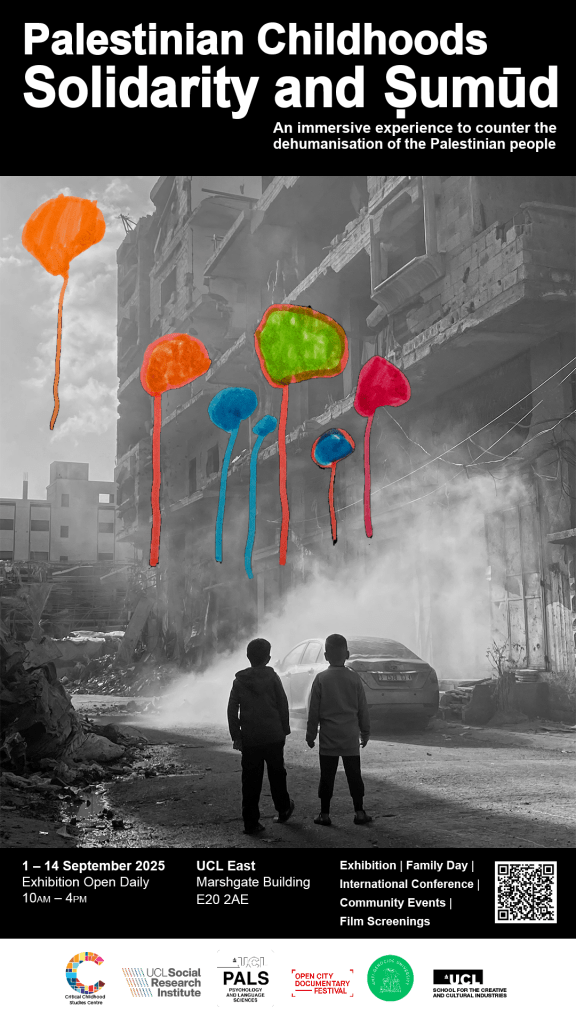
Palestinian Childhoods: Solidarity & Ṣumūd starts tomorrow, Monday 1st Sept (REGISTRATION ESSENTIAL)
A 2-week programme of art & daily events bearing witness to Palestinian children’s struggle for everyday life, love, play and learning in the face of loss and brutality.
Highlights include:
• Opening event 4-6pm with Dr Ghassan Abu-Sittah & artist Malak Mattar
• Exhibition of Palestinian artists daily 10am-4pm
• Family activity day (6 Sept)
• Community-based fabric arts & zine-making workshops (4 & 10 Sept)
• Film screenings: Tale of the Three Jewels, Giraffada
• Discussions centering the voices of Palestinian youths and educators hosted by SWANA Forum for Social Justice:
Title: “Contours of Solidarity and Sumud: Voices of Palestinian Educators and Children”
Time: Friday 12th September 2025 at 1:30pm online
In an attempt to sketch the contours of our solidarity with the sumud of Palestinian educators and students, SWANA Forum for Social Justice invites Dr Saida Afouneh (An-Najah University, West Bank) and Dr Fadel Alsawayfe (Bethelem University, West Bank) to share their experiences and collection of voices on education in Gaza during genocide. These two professors of education will tell us how Gazan children and teachers demonstrate sumud in and through teaching and learning. They will amplify these voices which are either unheard or ignored by those who have the power to end their suffering. This event will be held online, entailing a mixture of images, videos, story-telling and live conversation between Dr Saida, Dr Fadel and the co-founders of SWANA Forum for Social Justice.
@ UCL East, Marshgate E20 2AE. Registration links & full programme at: https://reimaginingchildhoodstudies.com/solidarity_and_sumud_exhibit/
Register HERE for this free Webinar
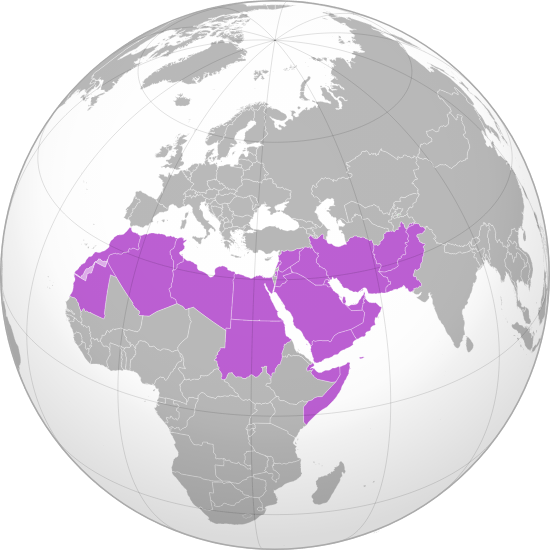
Webinars and Workshops held once a month (see our social media for details)
Guest Speakers’ Biographies:
Eleanore Hargreaves is Professor of Learning and Pedagogy and Academic Head of Research in the CPA department at the Faculty of Education and Society at UCL. Her research has focused on hearing the child’s perspective about schooling and classrooms and establishing the social justice of schooling practices. One of her recent books was called Children’s Experiences of Classrooms (SAGE, 2017). She has worked extensively in the SWANA region, in particular in Egypt.
Sherko Kirmanj is an Adjunct Professor at Koya University, Kurdistan Region, Iraq with a PhD in International Studies from the University of South Australia. He is the author of Identity and Nation in Iraq (published in English, Arabic and Kurdish); One Hundred Years after Sevres (published in Kurdish) and Islam, Politics, and State (published in Arabic and Kurdish). Dr Kirmanj has published thirteen articles and six book chapters in international refereed journals and academic volumes in English. He taught in Australia, Kurdistan Region in Iraq, Malaysia and the United Arab Emirates. He is currently British Academy Bilateral Chair in Education, Conflict, and Crisis, at Ulster University, UK.
Houda Mzioudet holds an MA in Cultural Studies from the University of Manouba (Tunisia) and is currently enrolled in a BA in Political Science and International Relations at the University of Toronto (Canada). As an independent researcher, she covered the so-called Arab Uprisings in 2011 with international news outlets such as the BBC, CBC and Al Jazeera English among others. Houda published pieces for international think-tanks like the Brookings Institution and the Carnegie Endowment for International Peace. She also co-authored a book on the Libyan Displacement Crisis with Megan Bradley and Ibrahim Fraihat in 2016 and has recently authored a chapter titled “Breaking the Racial Taboo: Black Tunisian activism as transitional justice” in the volume Transitional Justice in Tunisia: Innovations, Continuities, Challenges. Currently, her research focuses on transitional justice, border dynamics in North Africa, civil society activism, intersectionality, black identities in the SWANA region, gender and media, and migration and diaspora identities.
Cyrine Saab is a PhD candidate at the IOE, UCL’s Faculty of Education and Society with interests in forced migration and learning in everyday life. She is also a module tutor on Urban Sociology at UCL and is currently a British Academy Fellow at the Centre for Lebanese Studies and the University of Cambridge. Prior to her doctoral study, she worked for three years as a research assistant on large-scale projects that look at educational experiences for refugees in Lebanon.
Afsana Hamidy is a student at King’s College London in the MA International Child Rights and Development programme. She completed her first MA studies at the University of Roehampton in Inclusive Education, SEN and Disability. Currently, she work as a project coordinator with Student Action for Refugees.
Dalia Elhawary is a lecturer of EFL (English as a Foreign Language) Curricula and instruction at the Faculty of Education, Alexandria University. Her job involves working with prospective and in-service teachers. Her research has recently focused on exploring the experiences of primary school children when learning EFL in challenging and underprivileged contexts. Her research aims to understand and identify ways to bring about changes- particularly at classroom level- that could improve these children’s overall learning experiences and wellbeing.
Hamza R’boul is a Research Assistant Professor in the Department of International Education at the Education University of Hong Kong. His works examine interculturality, power relations and the skewed geopolitics of knowledge as they shape education and society at large. They also address inequalities and discuss the demands for more epistemic justice in intercultural communication education and research, sociology of education, internationalization of higher education and English language teaching.
Eugenie Samier is a Reader at the University of Strathclyde, Scotland. Her research concentrates on administrative philosophy, history and theory, interdisciplinary foundations of administration, theories of educational leadership, and comparative public and educational administration. She has frequently been a visiting researcher, a visiting fellow, and a guest lecturer at several universities in Europe and the Gulf States. She has edited several book collections on ethics, aesthetics, politics, ideologies, maladministration, identity, existential crises, and culturally sensitive research methods, and a book collection on teaching educational administration in Muslim countries. Her previous experience includes management consultancy to the public sector on legislation development, organisational reviews and development and has also worked with Canadian First Nations communities. Her current work is mostly on international, postcolonial and decolonising projects as well as Islamic social justice and administrative traditions within a broad humanistic framework.
Rola Koubeissy is an Assistant Professor in the Department of Psycho-pedagogy and Andragogy at Université de Montréal. She is a specialist in teaching and learning processes in context of diversity and inclusion. Her research interests concern teaching practices in multiethnic contexts and emergencies, learning process and inclusion of immigrant and refugee students, intercultural and inclusive pedagogy, critical pedagogy and issues of diversity and inclusion.
Ibrahim Al Houti is an Assistant Professor at Kuwait University and a non-resident fellow at Gulf International Forum in Washington, DC. He obtained his PhD from University College London’s Institute of Education where his thesis explored the politics of reforming the education system in the Arab Gulf region. He also holds two master’s degrees on Leadership and Comparative Education both from University College London’s Institute of Education. Dr Alhouti works on several educational projects and published six research papers about education and education reforms in the region. His research interest is focused on the politics of education, education reforms, comparative education, and education policies.
Andy Smart is an Education, textbooks, reading and publishing specialist. He started his career as an English teacher in Sudan and Egypt, before working in education and children’s publishing in the UK and Egypt. Now, he is working as an education and publishing consultant in English, Arabic and French. His interests and expertise are mainly in textbook policy and development, educational publishing sector development, primary education, curriculum development, literacy and children’s books development. Vice-president of the International Association for Research on Textbooks and Educational Media (IARTEM) and founder member of NISSEM.org, a practitioner–academic network that seeks ways of applying social and emotional learning to address SDG Target 4.7 through textbooks and educational materials.
Omar Kaissi is a Teaching Fellow (MSc Education) at Moray House School of Education and Sport, The University of Edinburgh. His specialism is sociology of education, with a focus on social research methodologies and methods, critical masculinities studies and critical education policy studies. Dr Kaissi is a member of the British Educational Research Association and Lebanese Association for Educational Studies.
Brian Lally is an educator with broad experience in teaching, education leadership, teacher/headteacher training, safeguarding/child protection and programme management as well as education research. He has worked extensively at local, regional and national levels in a range of countries and contexts. For several years he has been working mostly in Lebanon, but also in Turkey and northern Syria, as an Education Specialist with Syrian-led NGOs supporting refugee children and young adults through non-formal provision, schools, vocational training and in facilitating access to higher education. Brian is currently undertaking a PhD with Kingston University/St George’s (University of London), building on his experience in education provision in conflict and fragile contexts.
Reem Furjani is a researcher on critical heritage studies and cultural policies from Tripoli, Libya. She is Founder and Director of Scene for Culture and Heritage; Fellow at the University of Oxford Centre for Islamic Studies (OCIS); Fellow at the American Institute for Maghreb Studies (AIMS); Ambassador to ICOMOS General Assembly 2023; and Co-Founder of the Mediterranean Association for Data Interchange (MADI). Her interests lie in the intersections between critical sociology and management of culturally significant spaces. Her research work explores communal interpretations of heritage and socially-performative uses of it. She is also an Investigator at the INHERIT Heritage Resilience network based in Anglia Ruskin University, and Co-Pilot with the Arab Fund for Arts and Culture (AFAC). Contributing to regional cultural policies, Reem authored Libya’s Country Profile on Cultural Governance for EU’s MedCulture Programme; contributor to the Mediterranean policies recommendations at the Dialogue of the Two Shores in Marseille and to a number of UNESCO and Réseau Euro-Med France policy initiatives.
Ahmad Jaber (Benswait) comes from an indigenous minority in Kuwait made as ‘Bidoon’, meaning ‘stateless’, since the country’s independence in 1961. Left in limbo due to his legal status throughout his life, including as (waiting) asylee in the UK, he developed a particular interest in investigating the implications of temporality as a terrain of (resisting) social categorisation and social control. His current PhD project is titled “Time as a lens to the infrastructure of the stateless Bidoon diaspora in the UK”, and it digs into the semiotic workings of time as key to understanding the ramification of the Bidoon’s cause. In the presentation, more light will be shed on this, the purpose of this focus, the key literature with which it engages and the challenges it has involved so far.
Bassel Akar is an Associate Professor of Education at Notre Dame University – Louaize, Lebanon. His research and development work in education over the past decade has taken place in lower middle-income conflict-affected countries, namely Lebanon and those in the wider Arab region. Studies have focused on citizenship and history education, teacher agency for change and empowering learners through pedagogy. Dr Akar published a book on citizenship education, Citizenship education in conflict-affected areas: Lebanon and beyond (2019) and an article on empowering teachers as agents of change in “Citizenship education in conflict-affected areas and nation-states: empowering teachers for sustainable reform” (2020) in a special issue edited by Professor James Banks for Intercultural Education. In addition to co-editing three special issues (2020, 2021, 2022) on teacher agency for Public History Weekly.
Somayeh Rahimi is a PhD candidate and Centenary Scholar in the Centre for Applied Linguistics at UCL’s Faculty of Education and Society. Her PhD project focuses on the transnational (im)mobilities of Iranian women, their drivers and implications for social justice. Her research interests include (im)mobilites, sociolinguistics, intersectionality, ethnography of bureaucracies and feminist ethnographies. She holds an MA in Applied Linguistics from University College London, an MA in Ancient Iranian Languages and Culture from the University of Shiraz, and a BA in German Translation from the University of Isfahan. Somayeh has many years of experience teaching English as a Foreign Language and English for Academic Purposes, and has taught in a number of countries, including Iran, Turkey and the UK. She is currently working as a Postgraduate Teaching Assistant at UCL.
Reem Noureddine is a Chevening Scholar, and an early-career researcher and advocate in gender equality in education with experience in humanitarian aid and international development in conflict-affected contexts, like Syria. Her dissertation for the MA in Education, Gender and International Development (Distinction) from the IOE, UCL explored the intersection of inequalities with the impacts of the Covid-19 pandemic on the educational system in Syria, and the ways to “build back equal,” whilst learning from successful educational interventions in similar contexts, and based on evidence retrieved from literature on Syria and the wider region in the last few decades. Reem started her career as a volunteer in non-profit organizations before shifting to academic research.
Abdeljalil Akkari is a professor at the University of Geneva (ERDIE), Switzerland. His main publications include studies on international cooperation, multicultural education, teacher training and educational inequalities. He recently published two books on Intercultural Approaches to Education – From theory to practice (https://link.springer.com/book/10.1007/978-3-030-70825-2) and Global Citizenship Education. Critical and International Perspectives (https://link.springer.com/book/10.1007/978-3-030-44617-8)
Myriam Radhouane is a research and teaching fellow at University of Geneva, Switzerland. Her work is rooted in the international dimensions of education. In particular, she has worked on the training of teachers in issues relating to cultural diversity and migration. Her current research focuses on the schooling of refugee pupils. Alongside her research work, she coordinates several training courses in the field of education in emergency situations and teaches at bachelor’s and master’s levels.
Ayman Qwaider is a specialist in Education in Emergency (EiE) and Inclusive Education. For over four years, he has worked with the Inter-agency Network for Education in Emergencies (INEE) as a Community Facilitator and a Consultant. He also worked with UNESCO as an Education Consultant with his expertise in conflict-sensitive education and disability inclusion. Mr Qwaider presents his work into the state of pre-tertiary education in Gaza now and before October 7th 2023. He also talks about some of his inclusive education initiatives (like Gaza Children’s Cinema) in the Gaza strip.
Saida Affouneh is the Deputy President for Digitalization at An-Najah University in the West Bank. Dr Affouneh is a widely published academic and works on digital and e-learning in times of crisis and occupation in Palestine. She is campainger for digital education and social justice projects, especially related to Children’s Right to Education. Dr Affouneh shares insights into the state of education in the West Bank now and before the war on Gaza 2023-2024.
Rana Abu-Zhaya is a Lecturer in the Division of Psychology and Language Sciences at UCL. Previously, she was a lecturer in the School of Psychology at the University of Plymouth. She is a trained speech-language therapist and has worked with children with Autism and children with developmental language disorders. Her research program focuses on characterizing the multimodal multisensory features of infants’ language environments and examining how infants process information in such environments and learn from them. Specifically, she studies how various multimodal cues (e.g., touch, facial expressions) are combined with speech directed to infants, what kinds of information these cue combinations provide, and how their presence in the input may change as a function of development and differing cultural and linguistic backgrounds. She also explores the mechanisms that allow infants to learn from multimodal language input, and how this learning changes with development and experience.
Abdalhadi Alijla is a Palestinian social and political scientist and science advocate. Abdalhadi is the author of the “Trust in Divided Societies” by Bloomsbury Academics and I.B.Tauris UK., and co-editor of “Rebel Governance in the Middle East”. Abdalhadi is a Non-resident senior fellow at Arab Reform Initiative. He is the 2021 International Political Science Association Global South Award. He is a co-founder of Palestine Young Academy in 2020. He is an Associate Researcher and the Regional Manager of Varieties of Democracy Institute (Gothenburg University) for Gulf countries. He was a Post-doctoral Fellow at the Orient Institute in Beirut (OIB). Since 2021, he is an associate fellow within SEPAD, sectarianism, proxies and de-sectorisation at Lancaster University. He was the Co-Leader of Global Migration and Human Rights at Global Young Academy. Abdalhadi has a PhD in political studies from the State University of Milan and an M.A. degree in Public Policy and Governance from Zeppelin University- Friedrichshafen, Germany. He has been granted several awards and scholarships, including Gerda Henkel (2022), DAAD (2009), RLC Junior Scientist (2010), UNIMI (2012), ICCROM (2010), Saud Al-Babtin (2002) among others.
Osman Z. Barnawi is a Professor of Language and Education at the Royal Commission for Yanbu Colleges and Institutes, Saudi Arabia. He is the founding editor of Global South Perspectives on TESOL (Book Series: Routledge-Taylor and Francis Group). His research interests include the intersection(s) of language and political economy, social and education policy studies, the cultural politics of education, multilingual and multicultural studies, Global South studies, and international/transnational education. His recent books are The Past, Present, and Future of Higher Education in the Arabian Gulf Region: Critical Comparative Perspectives in a Neoliberal Era (Routledge, 2023), Transnational Assessment Practices in the Age of Metrics (Routledge, 2023), and International TESOL Teachers in a Multi-Englishes Community: Mobility, On-the-Ground Realities and the Limits of Negotiability (Multilingual Matters, 2022). His works appear in journals such as Language and Education, Critical Studies in Education, and Australian Review of Applied Linguistics, Critical Studies in Language Education, Applied Linguistics (Oxford University Press), Applied Linguistics Review, and British Journal of Educational Studies.
Yamila Hussein Shanna is a scholar, education, activist and public speaker dedicated to socio-economic and political justice, especially in Lebanon. Her work focuses on examining matrices of oppression and liberation within the context of settler colonialism and anti-Black racism.
We’am Hamadan is a Palestinian PhD candidate in Education at Cambridge University. Her research focuses on the intersection between education and technology, particularly exploring the transitional journeys of Information and Technology graduates from Higher Education to the labour market and from the labour market and or HE into TechHubs.
Maya el-Helou – a course instructor in the Department of Anthropology at the University of Toronto. Her work involves making sense of everyday life, questioning normative time, and exploring revolutionary temporalities. Maya’s research interests intersect with critical perspectives on memory and identity, making her a valuable speaker on Scholasticide.
Ramallah and Akka – two undergraduate students from UCL Encampment 2024. They preferred to use pseudonyms for the Webinar event where they will speak to their enactment of decoloniality at UCL.
Rima Karami Akkary is an Associate Professor of Educational Administration, Policy, and Leadership at the American University of Beirut. She chairs the Department of Education AUB and is the program advisor for the Educational Management and Leadership program. She holds a Doctorate in Education from Portland State University her expertise lies in K-12 Educational Administration, focusing on school principalship, organizational change, and educational policy. She is the director and principal investigator of the TAMAM project launched in 2007 to initiate school-based reform and research on how to build leadership capacity for sustainable improvement. The project has partners in 72 schools spanning 9 Arab countries and is a recipient of the 2021-2022 UNESCO-HAMDAN prize for teacher development. Karami chairs the executive committee of Shamaa, and the BOT academic committee at Ahliah School in Beirut, and serves on the executive committees of Taawon Association and Scholar Activists for Change and Learning (SAIL) cluster at AUB.
Joumana Assaf has been a secondary education teacher since 1997-1998, specializing in science subjects. She holds a master’s and a doctorate in chemistry from France and certificates in education from the Lebanese University and the American University of Beirut. Currently, she is a researcher at the Environmental Sciences Laboratory (PRASE) at the Doctoral Higher Institute of Science and Technology (EDST) – Lebanese University. Assaf has numerous publications in peer-reviewed scientific journals indexed on Scopus, Web of Science, and ORCID. She also serves as a reviewer for international education journals like The International Review of Research in Open and Distributed Learning (IRRODL), E-Learning and Digital Media Journal, and Contemporary Educational Technology. Her dedication to teaching and research fuels her passion for contributing to educational transformation.
Ruba Ali Al-Hassani presented her work at the September 2024 Webinar. She is an Interdisciplinary Sociologist and a Postdoctoral Research Associate at Lancaster University’s Department of Politics, Philosophy and Religion. Ruba is also a Research Consultant with King’s College London. She focuses on the study of state-society relations to centre and amplify voices on the ground in public discourse, analysis, and policy. Her research particularly focuses on Iraqi studies, law, transitional justice, crime, social control, and social movements. Ruba is a co-founder of the Canadian Association for Muslim Women in Law.
Mustafa Wshyar also presented in September 2024. He is an academic with over fifteen years of experience in teaching, research, and educational consultation. He holds a PhD in Literary and Cultural Studies from the University of Szeged and an MA in English Language and Literature from the University of Central Lancashire. Currently, he serves as a Research Associate at Ulster University and a Senior Lecturer at Koya University. Mustafa’s research, particularly on the “Literary Violence Triangle,” explores trauma, war, and conflict resolution. A polyglot, he is fluent in English, Turkish, Arabic, and Kurdish. He is also a distinguished member of the British Academy Early Career Researcher Network, reflecting his commitment to academic excellence and innovation.
Taziri El Omrani spoke at our Webinar in October 2024. She is the first female TV-reporter in Misrata, Libya in 2011 during the so-called Arab Spring. Taziri is an independent Libyan journalist, human rights defender, writer and researcher from Amazigh indigenous culture. She co-founded the Tmazight Women Movement in 2016, managed different projects with different organizations and is a former trainer at DW Academy. This year, she guest lectured on social work and activism at ArteVelde University in Belgium where she resides. She co-authored a book about her experience as an activist in Libya called “ Write to Speak,” a collection of African Women Leaders stories. She also collaborated in a cultural artistic project with Brussel Behoort Ons Toe and the Post Collective.
Brahim El Guabli is an Indigenous, Black and Amazigh scholar from Morocco. He presented at our monthly Webinar in October 2024. Associate Professor of Arabic Studies and Comparative Literature at Williams College, El Guabli is currently Associate Professor Comparative Thought and Literature at Johns Hopkins University. El Guabli is the author Moroccan Other-Archives: History and Citizenship after State Violence (Fordham University Press, 2023), which is a finalist for the African Studies Association’s Book Award, and Desert Imaginations: Saharanism and its Discontents (forthcoming). He is co-editor of Lamalif: A Critical Anthology of Societal Debates in Morocco During the “Years of Lead” (1966-1988) (Liverpool University Press, 2022) and Remembering Jews in Maghrebi and Middle Eastern Media (Pennsylvania State University Press, 2024). He is currently completing a third book tentatively entitled Literature and Indigeneity: Amazigh Activists’ Construction of a Literary Field. El Guabli is co-founder and co-editor of Tamazgha Studies Journal and the Amazigh Studies series (Georgetown University Press).
Sarra Boukhari presented to us in November 2024. She is a researcher specialising in refugee studies and an Associate Lecturer at Swansea University. She earned her PhD in Education from the University of Bath in 2023. Her overall research interest centres on exploring the integration experiences of refugee children and children’s voices and narratives, with a particular emphasis on using arts-based methodologies to understand their diverse perspectives. As a British Academy Postdoctoral Fellow, her ongoing research examines the experiences of refugee children in shared spaces within host societies, specifically in Bangladesh and Algeria. She is currently engaged in several projects that promote inclusion and social integration for refugee communities in the UK, utilising arts-based approaches to empower children and foster community cohesion.
Dr. Fella Lahmar also spoke at the November 2024 Webinar. She is a Senior Fellow of the Higher Education Academy (SFHEA) with extensive expertise in Islamic education, curriculum design, and educational leadership. Her widely published research encompasses Islamic education in Western contexts, research methodologies, and decolonial approaches. Dr Lahmar is a Research Fellow at The Open University, holding an MA in Islamic Studies from Loughborough University, an MA in Educational Research Methods, and a PhD in Education from the University of Nottingham. She has developed and directed higher education programs, supervised PhD, MA, and BA dissertations, and contributed to international curriculum projects, including collaborations with the Qatar Foundation. She is also actively engaged in advisory roles, policy development, and interdisciplinary collaborations to promote culturally inclusive educational practices.
Helen Beetham joined our Webinar panel discusssion with Dr Saida Affouneh (see above) and SWANA-FSJ co-founder Nidal Al Haj Sleiman (see Contact Us) in December 2024. She is a Researcher and Lecturer in Digital Education, based at the University of Manchester, UK. Her book Rethinking Pedagogy for a Digital Age (with Rhona Sharpe), is now in its third edition, and she has published peer-reviewed papers on topics from critical digital pedagogy to surveillance and decolonising technology. Helen has advised global universities in the UK, Europe, Africa and Australasia on their digital education strategies, and has worked for international bodies such as the EU, UNICEF, UNESCO and the Commonwealth of Learning. Her Digital Capabilities Framework is used in a majority of UK universities and she has contributed to influential frameworks in healthcare, culture and heritage, international college leadership, and European schools. She has most recently been involved in supporting emergency education for students in Gaza. Helen produces a regular blog and podcast, ‘Imperfect Offerings’, that is widely cited for its critical stance on AI in education: https://helenbeetham.substack.com/
Ghenwa Al Shoumari presented in our January 2025 Webinar. She is a human rights defender and PhD candidate in International Relations and Conflict Resolution at the University of Kent, UK. With over 10 years of experience in the SWANA region, she has worked with civil society, human rights, and feminist organizations. Ghenwa’s research sheds light on how the educational system has been used as a tool for top-down policies in Syria’s complex history and ongoing challenges.
Dr Benoîte Martin also presented in January 2025. She is a peacebuilding professional, having worked with various local and international non-governmental organizations for the last 20 years in Iraq and Syria. Her research interest focuses on interactions between education and conflict and has recently completed her PhD looking at politics of education in Northeast Syria. Dr Martin has contributed to the conduction of research on education in various parts of Iraq and Syria.
Dr Amel Khalil spoke to us in February 2025. Dr Amel is the Deputy Director, Head of Department of Gender and Social Work, and a lecturer at the Peace and Development Studies Centre in the University of Kordofan, Sudan. As the managing director of the Advanced Training Centre at Kordofan University, Amel is a coach and a trainer of trainers (ToT) in human development. She has also consulted on conflict resolution and engages the public by preparing and presenting the radio programme ‘Journal of Peace and Development.’ Dr Amel will present her topic on peace and development in Sudan in Arabic with her English-speaking interpreter at her side. Read her blog on UKFIET here: https://www.ukfiet.org/2024/the-role-of-universities-located-in-conflict-affected-zones-in-empowering-youth-and-women-as-effective-peacebuilders-a-comprehensive-approach/
Muzan Alneel presented in February 2025. She is a socialist writer and industrial policy researcher from Sudan with an interdisciplinary professional and academic background (engineering, socioeconomics, public policy). Muzan is the co-founder and managing director of ISTinaD Research Center – Innovation, Science and Technology for People Centered Development– in Sudan, and a research fellow at the Transnational Institute.
Asma Mustafa joined our Webinar in March 2025. She is an English Language Teacher at the Ministry of Education in Gaza since 2008. She won the Global Teacher Award in 2020, the Best Teacher in Palestine in 2022, and she is the Creative Teacher of Palestine Winner in 2022. Asma’s commitment to professional development is evident in being a Microsoft Innovative Educator Expert, an Apple Certified Teacher, a Google Certified Educator, a National Geographic Certified Educator and a member of Explorer Mindset National Geographic. She is a member of the Digital Empowerment in Education Team in the Ministry of Education, and the Ambassador of Education in Wakelet Community
Nayla Rida spoke at our Webinar in May 2023 and again in April 2025. She was awarded the title of UN Women UK Participant to the 66th, 67th and 68th Commission on the Status of Women (CSW), advocated with a rape relief centre, wrote for the Oxford Human Rights Hub, worked at the Iranian and Kurdish Women Rights Organization, and more recently at Global Dialogue on Afghan women’s rights. She holds a MA in Education, Gender and International Development from UCL’s Institute of Education and a MSc in Modern Middle Eastern Studies from the University of Oxford. Nayla also holds a certification from the Sexual Violence Research Initiative in quantifying violence against children, another one from the University of Iceland in Gender Violence in Post-Conflict States, and an additional one on Gender Perspectives on Disarmament delivered by the UN Office for Disarmament Affairs (UNODA), amongst others.
Helen Lackner was invited to speak in May 2025 as she has been involved with Yemen for more than half a century, working in all three Yemeni states which have existed since the 1960s. Ms Lackner has worked as a consultant in social aspects of rural development in over thirty countries in the Middle East, Africa, Asia and Europe. Her two most recent books on Yemen are Yemen in Crisis, Devastating Conflict, Fragile Hope (Saqi, 2023) and Yemen: Poverty and Conflict (Routledge, 2023). Lackner was the Sir William Luce Fellow at Durham University in 2016, an associate researcher at SOAS from 2016 to 2022. She edited the Journal of the British-Yemeni Society for eight years and writes regularly for the Arab Digest and Orient XXI and has contributed longer academic papers to numerous books and other institutions.
Almuatasim AlQadhi, a Yemeni researcher specializing in social anthropology and Middle Eastern studies, also joined us in May 2025. He holds an MSc in Social and Cultural Anthropology from University College London (2021) and is currently a PhD candidate at the University of Exeter, where he was awarded the Al-Qasimi Studentship. His research explores the intersections of anthropology, politics, and conflict, with a particular focus on Yemen. AlQadhi is especially interested in the ways war reshapes social structures, identities, and institutions—including education—within affected communities.
Tugay Durak presented his work on Turkish diaspora in July 2025. He is a PhD candidate in international higher education at University College London, very near finishing, and a Visiting Fellow at the University of Neuchâtel’s nncr-onthemove centre. His research lies at the intersection of international academic mobility, migration, and knowledge diaspora. His doctoral thesis investigates academic migration from Turkey to the UK. Tugay has held visiting scholar positions at Yale University, Boston College, and the University of Kassel. He has worked on research projects funded by the British Council and the Turkish Migration Research Foundation, and his work has been published in journals such as the Journal of Comparative & International Higher Education and International Higher Education. Before pursuing his postgraduate education at UCL, Tugay worked as a mathematics teacher in Istanbul for four years.
Estella Carpi is an Associate Professor in Humanitarian Studies at University College London and a Senior Visiting Fellow at the Lebanese American University who also spoke on Türkiye in July 2025. A social anthropologist by training, her work focuses on identity politics, the moral economy of humanitarianism, and urban and faith-inspired aid provision in Lebanon and Türkiye. Estella has contributed to numerous academic institutions and published extensively, including two recent books on forced migration and crisis-making in Lebanon. She also consults for NGOs on safeguarding issues.
 SWANA Forum for Social Justice